
Most businesses do not stop growing because they run out of customers. They stop growing because they run out of founder.
In the early stages of an enterprise, the founder is often the primary driver of success. They make the sales calls, solve the problems, answer customer queries, approve decisions, and hold much of the operational knowledge in their head.
At first, this works.
- At £100,000 / $130,000 turnover, it is commitment.
- At £1 million / $1.3 million turnover, it is dedication.
- At £4 million / $5 million turnover and beyond, it often becomes the bottleneck.
The very behaviours that created early success can become the barriers that prevent further growth. The businesses that continue to scale successfully tend to follow a predictable journey. They move through five levels of organisational maturity, gradually replacing founder dependency with scalable systems.
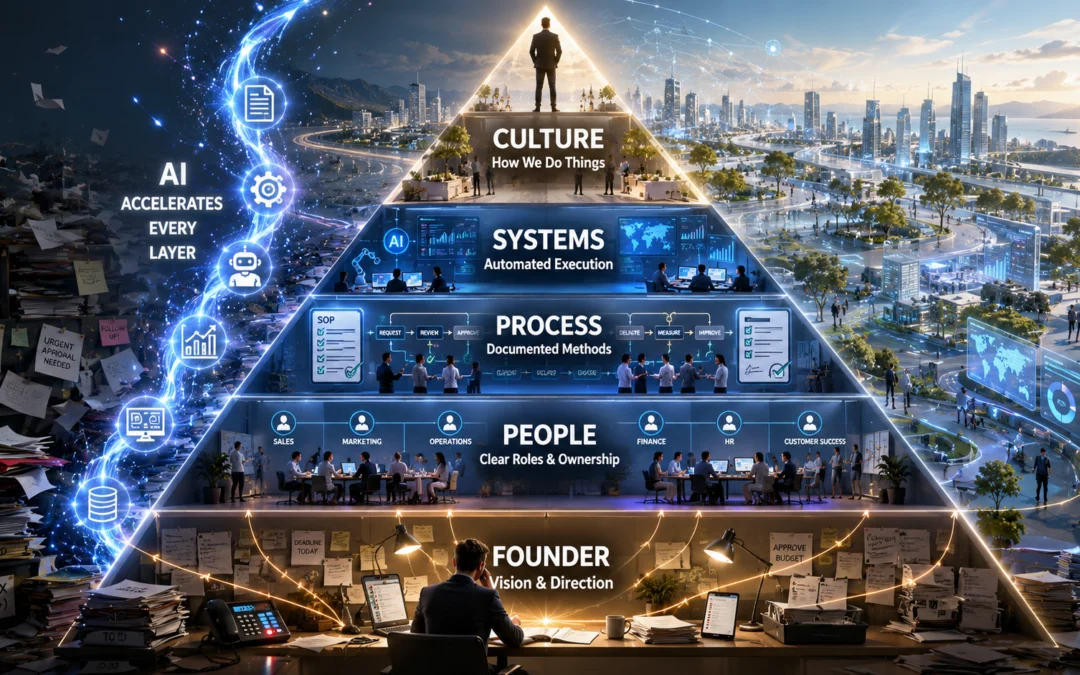
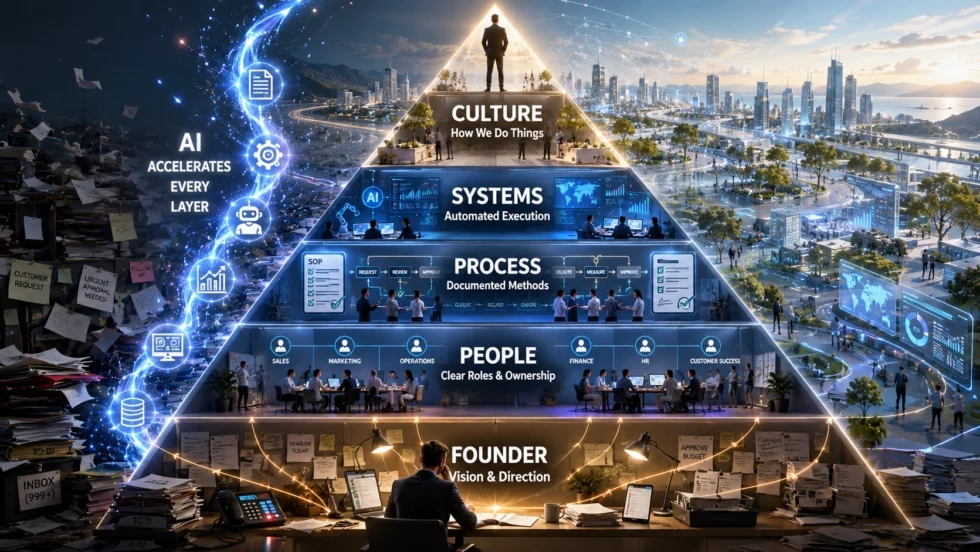
We call this the Hierarchy of Business Scale.
Level 1: Founder – Vision & Direction
Every business begins here. The founder drives the activity. Customers trust the founder. Knowledge lives with the founder. Decisions flow through the founder.
The business depends heavily on one person's energy, memory, availability, and expertise. This stage can be highly profitable, but it has limits. When every significant decision requires one person's involvement, growth eventually slows to the speed of that person's capacity.
The first ceiling has been reached.
Level 2: People – Clear Roles & Single-Point Ownership
The next stage is building capability beyond the founder. This is where clear roles, responsibilities, and single-point accountability begin to emerge across the core business seats: Sales, Marketing, Operations, Finance, People, and Customer Success.
Instead of asking, "Who can help me with this?"
The business starts asking, "Who owns this outcome?"
Adding people alone does not create scale. Many businesses hire more staff but remain founder-dependent because every important decision still travels back to the owner. Real progress happens when individuals are trusted with clearly defined outcomes and the authority to achieve them.
Level 3: Process – Documented Methods & Repeatability
As teams grow, consistency becomes the challenge. Without documented processes, every employee develops their own way of working. Results vary. Training becomes difficult. Knowledge leaves when staff leave.
Processes transform tribal knowledge into organisational knowledge. They provide a repeatable method for delivering quality, onboarding new staff, and maintaining standards as the business grows.
A business cannot consistently improve what it cannot consistently repeat. Process creates predictability, and predictability creates scale.
Level 4: Systems – Automated Execution & Connected Data
Once proven processes exist, systems become the force multiplier. Technology, automation, AI, and workflow management allow the business to execute consistently without relying on constant manual intervention.
- Leads are captured and qualified automatically.
- Tasks are assigned and tracked automatically.
- Customers are onboarded without friction.
- Financial and operational reports are generated in real time.
- Cross-functional communication is triggered automatically.
The goal is not to replace people. The goal is to remove unnecessary human effort from predictable activities. Good systems allow talented people to spend more time solving problems and less time repeating them. This is where many businesses experience their next major leap in capacity.
Level 5: Culture – How We Do Things Every Day
The highest level of business maturity is culture. At this stage, people no longer follow processes simply because they are instructed to. They follow them because they represent the accepted operational standard.
The organisation develops its own momentum. New employees quickly adopt established behaviours. Performance becomes self-reinforcing. Standards become embedded.
The founder is no longer the engine of the business; the founder becomes the architect. The business continues growing without requiring heroic effort from a handful of individuals. It operates through shared expectations, proven systems, and aligned behaviours.
This is where genuine enterprise scalability begins.
The AI Accelerator: Compressing Years into Weeks
Historically, climbing the hierarchy could take years. Building role structures, documenting processes, implementing systems, and embedding culture required significant management time and specialist expertise.
Today, AI is changing the economics of growth. The hierarchy itself has not changed. What has changed is the speed at which businesses can move through it.
Founder → People
AI can help create role descriptions, accountability frameworks, recruitment materials, onboarding programmes, and performance expectations. What once took weeks can now be completed in hours.
People → Process
AI can transform conversations into SOPs, meeting notes into procedures, training sessions into documentation, and tribal knowledge into shared assets. Processes that previously lived in people's heads can now be captured and refined rapidly.
Process → Systems
AI can identify repetitive tasks, workflow bottlenecks, automation opportunities, reporting requirements, and integration possibilities. It becomes far easier to build systems around proven processes.
Systems → Culture
AI helps reinforce accountability, consistency, visibility, performance measurement, and continuous improvement. When expectations are visible and feedback is immediate, cultural adoption accelerates.
The Real Opportunity
Many discussions about AI focus on replacing people. The more important opportunity is helping businesses become scalable faster. The businesses gaining the greatest advantage are not using AI to remove people; they are using AI to build stronger teams, better processes, smarter systems, and healthier cultures.
AI is not replacing the hierarchy. AI is accelerating the journey through it.
A Simple Diagnostic Question
Look at your business today. Which level are you operating at?
Founder. People. Process. Systems. Or Culture.
More importantly, what is the next level you need to build?
Growth rarely requires working harder. More often, it requires building the layer above the one you are standing on. That is the transition from being the engine of the business to becoming its architect.
And that is where true freedom, resilience, and scale begin.
Where Do You Go From Here?
Understanding the hierarchy is the first step. Installing it into your day-to-day operations is what drives enterprise value and predictable growth.